Showing posts with label Glass. Show all posts

Friday, August 3, 2007

Free Films on August 4

In the spirit of this year's Orpheus themed-season, Glimmerglass is hosting free film screenings of Jean Cocteau's Orphée and Marcel Camus' Black Orpheus at the Fenimore Art Museum.
Cocteau's Orphée plays:
August 4 at 11:00 a.m.
August 16 at 3:30 p.m.
August 21 at 5:30 p.m.
Black Orpheus plays:
August 4 at 2:00 p.m.
August 18 at 11:00 a.m.
August 24 at 3:30 p.m.

Monday, July 30, 2007

From the Screen to the Stage

Harry Potter's done it. So have the Geico cavemen and the Incredible Hulk. The crossing of a story from one medium to another is the current obsession of the western media. However, movie and TV producers aren't the only ones borrowing from another medium. More and more modern composers have taken their libretti from the stories already made popular by film.


This season, Glimmerglass Opera is presenting the genre-jumping opera Orphée by modern composer Philip Glass. The opera is based from Jean Cocteau's 1950 film by the same name. From 1993-1996 Glass wrote an entire opera trilogy based on the films of Jean Cocteau: Orphée, La belle et la bête (Beauty and the Beast), and Les enfants terribles (The Terrible Children). Each opera shows a closer merge between the genres. Glass composed Orphée by using Cocteau's screenplay as his libretto. Glass meant La belle et la bête to be performed as an concert opera, with the film without sound playing simultaneously in the background.
However innovative Glass' operas are, he is not the first or last composer to use a film as inspiration for an opera.

Upcoming:

  • Dancing in the Dark by Poul Ruders, based on Lars Von Trier's award-winning film (2000) by the same name, which featured Bjork
  • The Fly by Howard Shore (Oscar-winning composer of Lord of the Rings) based on the David Cronenberg film (1986) by the same name which featured Jeff Goldblum. Placido Domingo will music-direct the production.

Composers are using films as inspiration for opera more and more, but currently it's far more common for novels to cross into operas. It's been happening for centuries.

  • Wagner--Baron Edward Bulwer-Lytton's Rienzi, Last of the Tribunes
  • Tchaikovosky--Pushkin's Eugene Onegin
  • Richard Strauss--Wilde's Salome
  • Korngold--Die Tote Stadt after Rodenbach's Bruges la morte
  • Prokofiev- Tolstoy's War and Peace
  • Britten--Henry James' The Turn of the Screw
  • John Harbison--Fitzgerald's The Great Gatsby
  • Mark Adamo--Alcott's Little Women
  • Poul Ruders-- Atwood's Handmaid's Tale, Kafka's The Trial
  • Tobias Picker--An American Tragedy

However, many of these stories are best known by their classic film adaptations:

Images courtesy of NYPL Digital Gallery.

Hot Links:
Cronenberg's The Fly to transform into an opera--CBC.ca
Opera to retell classic tale of love and insecticide-The Sydney Morning Herald
New Opera to Be Based on Von Trier Film--AP
Lost Highway, Opera Based on David Lynch Film, Gets New York Premiere--Playbill Arts
Opera and Film: Can This Union Be Saved?--Washington Post
Opera by the Book--Village Voice
The Novel of the Opera--Norman Lebrecht

Tuesday, July 24, 2007

Through the Glass Darkly

Last week the creative team and singers of Philip Glass' Orphée moved from the gymnasium of Richfield Springs High School to the stage of the Alice Busch Opera Theater. It was during this week that all of the elements of the show came together to form one cohesive artistic production. During each rehearsal, about 20 people from various departments were in the house of the theatre and about 10 are in the lighting booth and backstage, running the show and taking notes. Some of the corrections, like music and lighting cues, were addressed immediately. Other corrections were made later--changes in costuming, wigs and make-up, and set details.

Director Sam Helfrich explained the challenges he faces during a tech rehearsal. "I've spent three weeks in a room sitting in this one place at this one table, watching the stage from about five feet away and creating the show. The minute you move out into the house and start watching the show from 50 feet away, 100 feet away, it changes. Now it's a question of finessing things."

While looking forward to the show's opening and all the work ahead, the creative team took time last Wednesday to look back at the work they've done so far and present it to the entire staff of the opera. Orphée is based directly from French filmmaker Jean Cocteau's film of the same name. Helfrich's first concern was translating a 1950 film with over 15 sets and effects -- such as reverse motion and people walking through mirrors --into a viable opera.

"You can't avoid--I almost regret it now-- starting out by watching the movie. It's such a beautiful and exquisite piece of filmmaking that the designers and I made the decision early on to try to find a way to approach this piece that would be theatrical, that would work on the stage and that would really have something to say that was contemporary and modern and of its time," Helfrich said.

The design team decided to create one set for the entire opera, rather than 15. It is set up like a living room--complete with walls, ceiling, and realistic furniture. It took over 5 hours to put all the pieces on stage for the first time.

Lighting was a challenge because of the shape of the set. During the seminar, nearly everyone on the creative team pointed out lighting as one of their major challenges during the tech rehearsal process.
"It should be noted that this actually is an enormously difficult set to light. It's not just because it has a ceiling. There are some limitations on what you can do from above, but we wanted to do it all using practical lighting fixtures. It's very tricky finding a balance between looking at the lighting fixtures themselves and looking at a person's face lit next to a light fixture," Andrew Lieberman, Set Designer, said.

Production Manager Matthew Kirby-Smith pointed out that the "practical lighting" is not always enough to fully light the stage. "There are lighting instrument hidden throughout backstage--over doors, in alcoves, etc. We placed lighting instruments anywhere we could to help."

Mirrors play a large structural and thematic role in the opera. To create the same atmosphere as the mirrors in the movie, each major character has a double that matches them exactly in hair, make-up, and wardrobe.

To Wig and Make-up Designer Anne Ford-Coates, the doubles presented a special challenge. "With Caroline Worra, her natural appearance makes it very easy to believe that she would have the big heart that would anchor a really temperamental artist for years. That's already there, so there wouldn't be the need to change that, except when we get to Brenda Rae, her double, who has dark hair and a different look. We have to style Caroline so she can be Eurydice, but also so that Brenda can be her for a split second on stage."

Thursday, June 28, 2007

Insider Rehearsal Report: Principals at Play

The rehearsal process involves many different types of rehearsals: choral rehearsals, technical rehearsals, dress rehearsals, etc. Early rehearsals with the principals take place away from the theater, but are important in allowing principals to develop their characters in the context of the creative team's concept of the production.

In Thursday's Glass rehearsal, the focus was staging the scene in the opera that is most like a sitcom--when Orphée and Eurydice come back to their home from the underworld and Orphée is not allowed to look at her. The scene is chock-full of rapid dialogue over orchestration composed in a cellular style, with phrases of music are repeated again and again. There are also timing issues to tackle, such as Orphée casting near-glances at Eurydice without actually looking at her and making the whole thing look accidental, yet natural.

Director Sam Helfrich began by talking through the scene with singers Philip Cutlip (Orphée), Caroline Worra (Eurydice), Jeffrey Lentz (Heurtebise) and conductor Anne Manson. Discussion jumped to character conceptualization, pivotal points in the work, and interpretation of Glass and Cocteau's work. As they talked in the school gymnasium, the group lounged on the set.

Working with the principals also allows Manson to work in-depth on the music in the scene. Working on music is essential for any opera, but especially a piece that is not in the standard repertoire. Often, all the music is new to the singers until they are cast. Since the singers learned the music and words before they arrived, only small adjustments--a word here, an entrance there--were needed. Even when the singers were just sitting and singing, they were still rehearsing facial expressions and the occasional gesture.
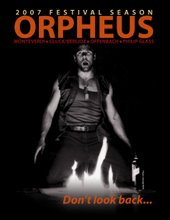
Helfrich's excitement often mirrored that of the principals', lending an air of dynamic creativity to these rehearsals. "I have such a good way for you to get back from the underworld. I'm dying just to do it and watch it."

For more rehearsal photos from the Glass, click here.

Monday, June 18, 2007

Insider Rehearsal Report: A Blank Slate for New Orphée

Beginning work on any opera is exciting. However, beginning work on a modern opera that's only been staged 3 times in North America--that's a landmark moment for any company. The opera in question is, of course, Philip Glass' Orphée, which premiered in 1993 at the American Repertory Theatre in Cambridge, Massachusetts. Glimmerglass rehearsals began Monday. Director Sam Helfrich created a open atmosphere by using the first meeting to share his conceptualization of the show and encourage discussion amongst the cast and crew.
Artistic and General Director Michael MacLeod began the rehearsal by introducing himself and the idea behind the season-- why Orpheus? To follow the distinguished 29-year tenure of Paul Kellogg, MacLeod searched for an imaginative way to make a mark on the company for his first season. To his surprise, three of perhaps the most famous operas based on the Orpheus myth had never been done at Glimmerglass, and it only seemed appropriate to do a season of Orpheus in 2007, the 400th anniversary of the first widely-recognized opera, Monteverdi's L'Orfeo. "The four operas complement each other perfectly," he said. "You can't ask for a wider range of style."

Unique style won't be a problem for Helfrich, who is directing the only modern opera of the season. Glass' Orphée is based directly on the 1950 film by French director Jean Cocteau, which integrated modern film techniques such as reverse footage. Helfrich and the show's designers made a conscious decision to move away from the staging and scenery of the film version. "It's a beautiful movie, and with beautiful movies, it's easy to get lured into aesthetics. I thought, we have to get into this piece in some other way."

The piece, as well as the movie it's based on, presents a host of puzzles. Helfrich touched on this, discussing the second to last scene in the opera, where the Princess lets Orpheus go, supposedly for some greater good. "That's a huge question without an easy answer," he said. Conductor Anne Manson pointed out similar challenges with the score. "One of my first frustrations in looking at the score was that the orchestration reveals so little about the inner lives of the characters. The music doesn't give you clear answers."

Fortunately, with no clear answers, the potential for creativity in all areas of the production process is nearly limitless. For Helfrich, rehearsals are a mental process, complementing the physical process of staging. He encourages the actors and the audiences to talk about these questions. "This piece will be a success to me if I leave the audience not only asking what just happened, but dying to talk about it."