The Last Premiere
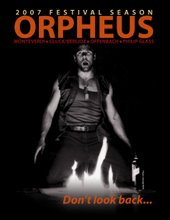
This Saturday marked the fourth and final opera premiere of the Glimmerglass 2007 season, Monteverdi's L'Orfeo. The opera is a co-production between Glimmerglass and Opera North (Leeds, England). In 2008, Opera Norway will also produce the opera.
L'Orfeo is one of the most historically significant operas ever written. Although composers had experimented with combinations of music and drama before, the opera is generally considered the "first" opera and is certainly the earliest performed with any real regularity.
 During a production seminar last Wednesday, conductor Antony Walker explained the evolution of opera before Monteverdi. "Fifty years before this was written, there were many documented, large-scale celebratory pieces that sometimes had a narrative going through them. A little analogy might be the musical theatre of today, which had a lot of spoken dialogue and then some songs as well. Then we had people asking, 'What did the Greeks used to do? What did they do with their dramas and how can we possibly hearken back to the Hellenic times and recreate what they might have done?' So, they came up with this sung recitation, which was accompanied by continuo-- it wasn't so much a song, but a narration."
 As historically notable as the music is, director Christopher Alden strives to bring modernity to the production. "This version of the opera is very much about Orpheus as an artist. We're talking about art and what it means to be an artist. To me what's fascinating about this piece is Eurydice is like Orfeo's art, his muse, his creativity. It was so long before she gave in to him. That's when he created all this amazing music, out of his longing for her. And then, as soon as he gets it, she dies--it's taken away from him. When you want it, when you are really hungry for it, that's when you are creative, but as soon as you get that thing and are paid for it and are successful on some level, it's gone."
 The opera is the centerpiece of the season, the one that General and Artistic Director Michael MacLeod built the season around to celebrate the 400th anniversary of its premiere. "I think it's extraordinarily lucky that in 2007, the 400th anniversary of Monteverdi's L'Orfeo, that we have the chance to present it at Glimmerglass for the first time. In fact, that was the germ of the idea of having an entire season based on the Orpheus myth," MacLeod said.


 Director Christopher Alden has a plan. Having already directed the show with